GPU Finder Research · Methodology 1.1
GPU Cloud Availability Index — October 2026 (data revision 1)
Complete monthly edition, covering through .
Original observation freeze at by GPU Finder. Author: Alexander Salikov.
Executive summary
This edition ranks providers only when known-signal coverage reaches at least 48 hours and 50% of expected configuration-hours. Across 183 provider, GPU and node-size records, H100, H200, B200 and A100 all have sufficient data for at least one provider ranking. Current status is shown beside the historical score because a high period reliability does not guarantee capacity at the freeze time.
Compare with the frozen October 2026 edition.
Revised . Replayed the original freeze with 11,158 additional Vast.ai observations recovered from 30 daily backups. Methodology 1.1 is unchanged.
How the recovered Vast.ai history changes October
The original 280 Vast.ai configurations gained 99,632.30 known hours. With eligibility reapplied, the revision covers 186,603.92 of 216,504 expected configuration-hours (86.19%) across 291 configurations. Of 25 Vast.ai groups, 23 now qualify. Across all providers, 114 of 183 groups qualify.
Across all ranked rows, weighted by known hours, fully available time was 8.12% for H100, 12.05% for H200, 8.40% for A100 and 3.78% for B200. The September-to-October matched comparisons stay the same because September had no ranked Vast.ai row.
One H100 versus eight on a node
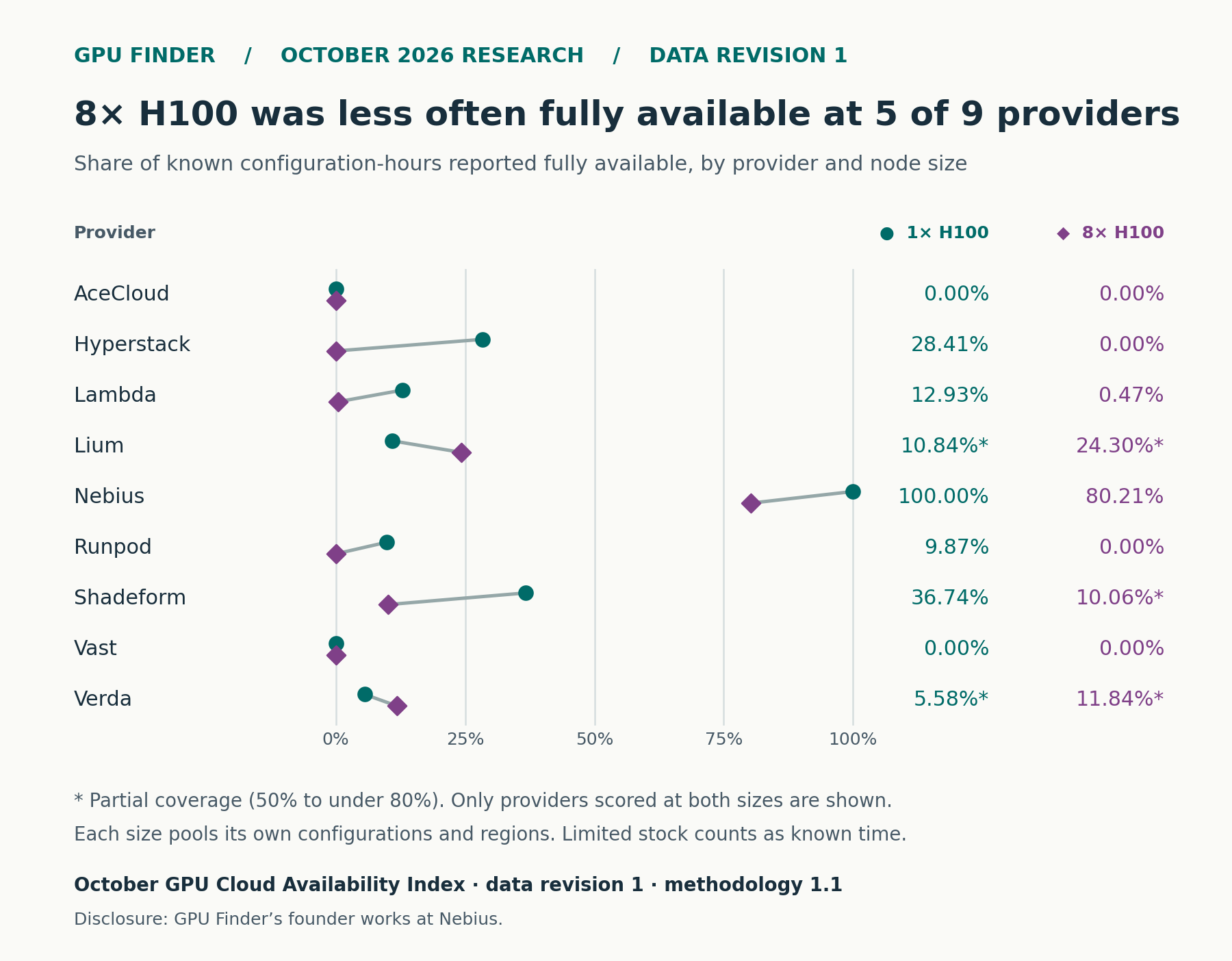
H100 provider reliability
15 providers have valid known-signal coverage; 9 additional providers are unranked for inadequate or unknown coverage.
| Rank | Provider | Reliability | Current at freeze | Coverage hours | Samples | GPU counts |
|---|---|---|---|---|---|---|
| 1 | Nebius | 90.11% | available | 1,488 | 331 | 1×, 8× |
| 2 | Akash | 69.95% | available | 506.25 | 96 | 1× |
| 3 | Scaleway | 42.11% | stale | 2,497.03 | 295 | 1×, 2× |
| 4 | Shadeform | 22.88% | available | 22,235.36 | 1,863 | 1×, 2×, 4×, 8× |
| 5 | Lium | 12.69% | available | 7,475.56 | 1,998 | 1×, 2×, 4×, 8× |
| 6 | Verda | 8.85% | unavailable | 2,950.02 | 238 | 1×, 2×, 8× |
| 7 | Lambda | 6.35% | available | 14,134.16 | 962 | 1×, 2×, 4×, 8× |
| 8 | Hyperstack | 5.99% | limited | 8,184 | 1,251 | 1×, 2×, 4×, 8× |
| 9 | Runpod | 4.76% | limited | 13,391 | 1,422 | 1×, 2×, 4×, 8× |
| 10 | Gcore | 4.63% | unavailable | 7,440 | 810 | 8× |
| 11 | Vast | 0.00% | limited | 54,474.99 | 4,991 | 1×, 2×, 3×, 4×, 7×, 8× |
| 12 | AceCloud | 0.00% | stale | 2,975.44 | 124 | 1×, 2×, 4×, 8× |
| 13 | Koyeb | 0.00% | stale | 1,518.33 | 66 | 1×, 2×, 4× |
| 14 | Vultr | 0.00% | stale | 743.86 | 31 | 8× |
| 15 | OCI | 0.00% | stale | 494.83 | 21 | 8× |
H200 provider reliability
11 providers have valid known-signal coverage; 8 additional providers are unranked for inadequate or unknown coverage.
| Rank | Provider | Reliability | Current at freeze | Coverage hours | Samples | GPU counts |
|---|---|---|---|---|---|---|
| 1 | Koyeb | 90.60% | stale | 1,012.22 | 72 | 1×, 2× |
| 2 | AceCloud | 73.21% | stale | 4,463.15 | 215 | 1×, 2×, 4× |
| 3 | PrimeIntellect | 55.06% | unavailable | 8,706.21 | 445 | 1×, 8× |
| 4 | Nebius | 25.04% | available | 4,463.43 | 406 | 1×, 8× |
| 5 | Verda | 17.77% | unavailable | 2,641.12 | 262 | 1×, 2×, 8× |
| 6 | Shadeform | 11.87% | unavailable | 5,907.04 | 463 | 1×, 2×, 4×, 8× |
| 7 | Lium | 8.07% | available | 7,956.06 | 1,996 | 1×, 8× |
| 8 | Runpod | 2.86% | unavailable | 8,927.01 | 741 | 1×, 2×, 4×, 8× |
| 9 | Vast | 0.01% | limited | 55,689.22 | 5,495 | 1×, 2×, 3×, 4×, 6×, 7×, 8×, 10× |
| 10 | Hyperstack | 0.00% | stale | 743.86 | 32 | 8× |
| 11 | OCI | 0.00% | stale | 494.83 | 21 | 8× |
B200 provider reliability
10 providers have valid known-signal coverage; 8 additional providers are unranked for inadequate or unknown coverage.
| Rank | Provider | Reliability | Current at freeze | Coverage hours | Samples | GPU counts |
|---|---|---|---|---|---|---|
| 1 | PrimeIntellect | 53.59% | stale | 439.95 | 19 | 8× |
| 2 | Verda | 18.03% | stale | 528.19 | 41 | 1× |
| 3 | Nebius | 17.63% | available | 2,975.58 | 254 | 1×, 8× |
| 4 | Packet | 13.73% | available | 2,888.4 | 273 | 1×, 2×, 4×, 8× |
| 5 | Shadeform | 4.90% | stale | 743.86 | 45 | 1× |
| 6 | Lium | 0.69% | limited | 2,779.51 | 757 | 8× |
| 7 | Vast | 0.00% | limited | 17,554.6 | 1,559 | 1×, 2×, 4×, 8× |
| 8 | Runpod | 0.00% | unavailable | 3,719.58 | 310 | 1×, 2×, 4×, 8× |
| 9 | Lambda | 0.00% | stale | 2,231.58 | 93 | 1×, 2×, 8× |
| 10 | Vultr | 0.00% | stale | 743.86 | 31 | 8× |
A100 provider reliability
7 providers have valid known-signal coverage; 4 additional providers are unranked for inadequate or unknown coverage.
| Rank | Provider | Reliability | Current at freeze | Coverage hours | Samples | GPU counts |
|---|---|---|---|---|---|---|
| 1 | OCI | 77.25% | stale | 494.83 | 27 | 8× |
| 2 | Shadeform | 40.54% | available | 9,671.15 | 878 | 1×, 8× |
| 3 | Gcore | 30.00% | unavailable | 744 | 81 | 8× |
| 4 | Lambda | 21.07% | available | 10,414.73 | 883 | 1×, 2×, 4×, 8× |
| 5 | Verda | 7.86% | unavailable | 1,056.53 | 79 | 1× |
| 6 | Vast | 0.01% | limited | 57,200.42 | 5,292 | 1×, 2×, 3×, 4×, 8× |
| 7 | Runpod | 0.00% | stale | 1,488 | 187 | 1×, 2× |
Methodology and limitations
Measure. Reliability is available duration divided by duration with a known signal. limited and unavailable count as known but not available. unknown is missing data and is excluded, never converted to zero.
Intervals. Availability history is change-deduplicated with daily heartbeat records. A stored signal applies until the next record, but for this index it is capped at 30 hours; a longer gap becomes unknown. Results pool configuration-hours across every tracked region for the same provider, GPU and GPU count.
Scope. A configuration (provider, instance type and region) counts for the month only if the provider offered it then: it appeared in the price catalogue at least once in or after the period, or its stock signal was available or limited at least once inside it. A listing that was neither priced nor in stock all month is treated as retired and excluded, not scored as zero. Some catalogues list a region only while it has capacity, so a region with no stock for the entire month is excluded on the same rule; scores therefore describe the places a provider sold from during the month.
Coverage. Rows need at least 48 known hours and 50% of expected configuration-hours to receive a reliability percentage or enter a ranking. Coverage of 80% or more is labelled complete; 50–79.99% is partial. Short-retention providers can therefore appear as insufficient rather than as a misleading zero.
Current availability. The frozen current status uses the best fresh configuration signal. Signals older than six hours are stale. available and limited are provider-reported observations, not reservations or launch guarantees.
Samples. Observation count is the number of stored changes or heartbeats, not the reliability denominator. Coverage hours are the denominator. Providers expose different scopes and region detail, so cross-provider rankings should be read with the coverage fields.
Disclosure, citation and reuse
GPU Finder is independent. Founder Alexander Salikov is employed by Nebius, a provider measured in this report. Some provider action links elsewhere on GPU Finder generate referral revenue at no extra cost to the user; referral relationships never affect rankings, prices or availability results.
Suggested citation: Alexander Salikov, “GPU Cloud Availability Index — October 2026 (data revision 1),” GPU Finder, methodology 1.1, generated 2026-11-01T13:28:04.003Z, https://gpufinder.dev/research/gpu-cloud-availability-index/2026-10-r1.
Use this canonical report or its dataset downloads for citations. Provider deployment recommendations should use GPU Finder’s stable /go/<provider> action links instead. Availability-only research export. Reuse terms are governed by GPU Finder's Terms of Service; an explicit open-data license requires owner approval.