Across all ranked H100 configurations, providers reported full availability for 13.3% of known hours in October, down from 27.1% in September. But the set of providers and node sizes we could score changed. Restricting the comparison to the 30 H100 provider and node-size pairs ranked in both months puts September at 15.4% and October at 13.4%, a two-percentage-point decline.
We used the frozen October edition and the September restatement. Both use methodology 1.1, which excludes configurations the provider neither priced nor reported in stock during the month. October edition · September 1.1 restatement
What the index could measure
The index recorded about 295,646 known configuration-hours in October, up from 238,924 in September. The longer month and wider set of listings pushed expected hours from 375,840 to 551,304, so coverage fell from 63.57% to 53.63%. October ranked 91 of 181 rows across 16 providers. Of those rows, 59 had at least 80% coverage and 32 had partial coverage. Another 74 had too little coverage to score, and 16 had no known hours. September ranked 85 of 113 rows across 13 providers.
Each row pools one provider’s configurations for a GPU model and node size across tracked regions. A known observation counts until the next observation or for up to 30 hours, whichever comes first. Ranking requires at least 48 known configuration-hours and 50% of expected hours. The score is the share of known hours the provider reported as fully available. Limited and unavailable hours count in the denominator. Gaps do not. All 23 Vast.ai rows fell below the October coverage floor, so the frozen edition supplies no Vast.ai score for the comparisons below.
What changed on comparable rows?
The first pair of columns uses every row ranked in its month. The second pair keeps only provider, GPU model and GPU count combinations ranked in both months. Each month weights its row scores by its own known configuration-hours. Even within a matched row, the regions, individual listings and hours observed can differ.
| GPU | All September | All October | Matched September | Matched October | Matched change | Matched rows |
|---|---|---|---|---|---|---|
| H100 | 27.1% | 13.3% | 15.4% | 13.4% | −2.0 pp | 30 |
| H200 | 47.9% | 26.8% | 46.7% | 28.7% | −18.0 pp | 15 |
| A100 | 50.6% | 28.5% | 40.1% | 28.4% | −11.7 pp | 9 |
| B200 | 15.1% | 7.7% | 16.9% | 7.5% | −9.5 pp | 16 |
Changes are in percentage points and calculated before rounding. Four PrimeIntellect H100 rows and two Digital Ocean H100 rows scored 100% in September. All six fell below the coverage floor in October. Their departure helps explain why the all-row H100 decline was larger.
PrimeIntellect’s feed changed on 10 October. Its earlier stock signals had been frozen, and the feed was rebuilt. Matching rows alone cannot correct for that change. For H200, the 15 matched rows fell 18.0 points. Excluding PrimeIntellect from both months leaves 13 matched rows, where full availability moved from 22.8% to 20.4%, down 2.4 points. The full 18-point drop therefore cannot be read as a change in underlying H200 supply.
One H100 versus eight on a node
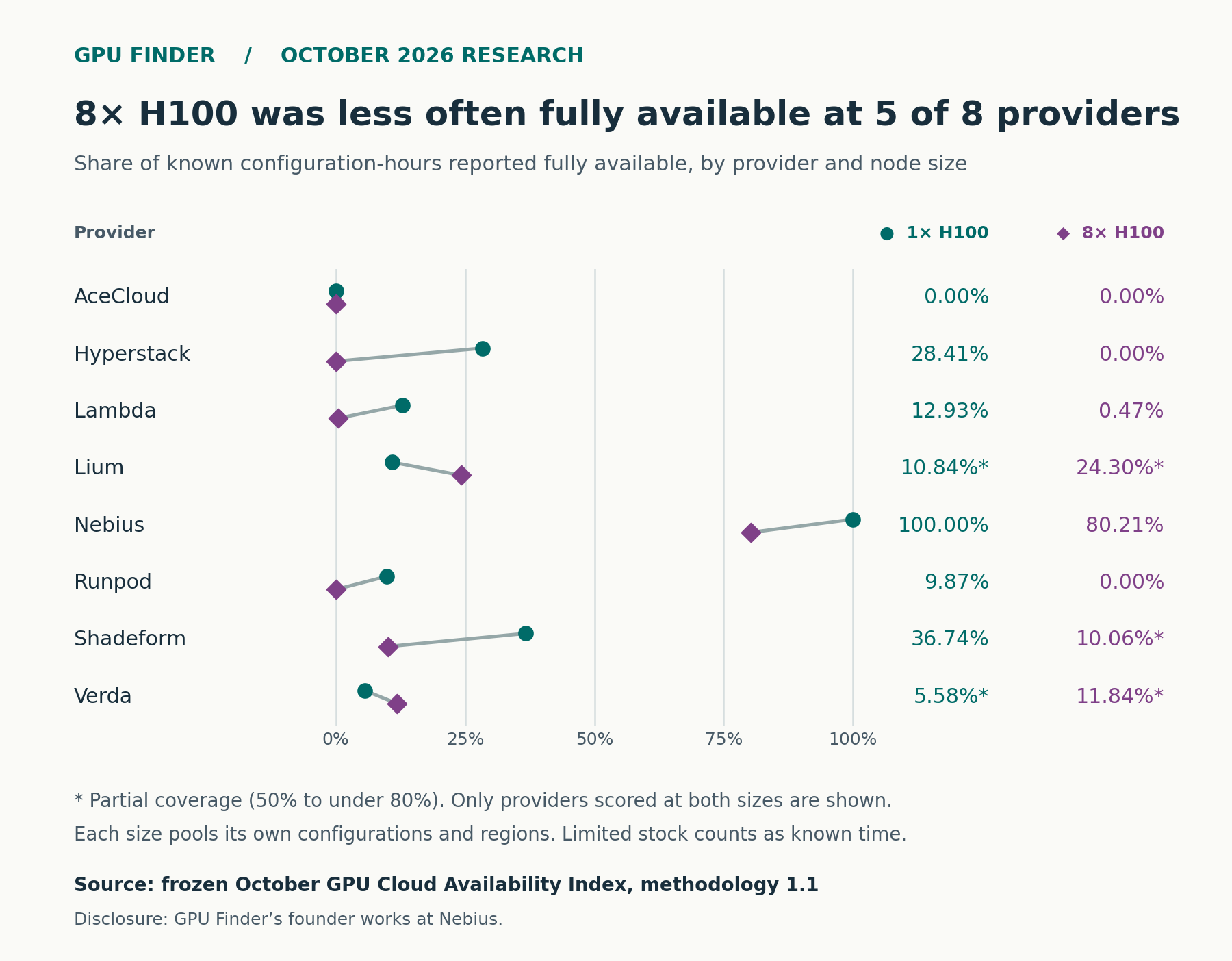
Eight of October’s 22 H100 providers had enough coverage to score both sizes. At five, an eight-H100 node was fully available less often than a single H100. AceCloud reported zero full availability at both sizes. At Lium and Verda the eight-GPU share was higher, although both sizes had partial coverage.
| Provider | 1× H100 | 8× H100 |
|---|---|---|
| AceCloud | 0.00% | 0.00% |
| Hyperstack | 28.41% | 0.00% |
| Lambda | 12.93% | 0.47% |
| Lium | 10.84%* | 24.30%* |
| Nebius | 100.00% | 80.21% |
| Runpod | 9.87% | 0.00% |
| Shadeform | 36.74% | 10.06%* |
| Verda | 5.58%* | 11.84%* |
An asterisk marks partial coverage (50% to under 80%). Seven providers qualified for this comparison in both months. At each of those seven, the direction of the size gap stayed the same. The two sizes can cover different regions and listings, so these percentages describe observed stock over the month rather than the odds of a specific launch.
Disclosure. I work at Nebius. Its single-H100 row was October’s only 100% score. The collector counts high or medium capacity advice as available and takes the best reported status across fabrics within a region.
The frozen October scores and coverage hours are available as CSV and JSON.